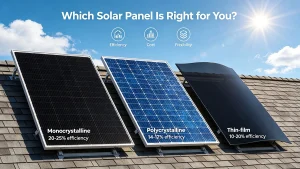
Walk into any solar discussion and you will quickly hear three terms: monocrystalline, polycrystalline, and thin-film. They sound technical, but the differences between them are straightforward — and they matter for your roof, your budget, and your energy bills over the next 25 years.
This guide breaks down each panel type in plain language, compares them honestly, and gives you a simple framework for choosing the right one for your home.
1. Monocrystalline Solar Panels: The Premium Choice
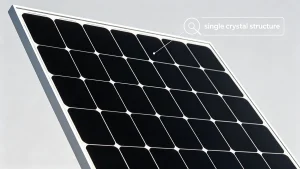
Monocrystalline panels are made from a single, continuous silicon crystal grown using the Czochralski process. Because the crystal structure is uniform, electrons flow through it more smoothly, with fewer interruptions.
1.1 Appearance and Efficiency
You can recognize monocrystalline panels by their dark black color and uniform appearance. They are the most efficient type available, with residential modules typically achieving 20–23% efficiency. Premium N-type panels now reach 22–24%, and the most efficient panels in 2026 break 25%. TOPCon dominates volume production with top models at 23.8–24.0%.
1.2 Performance Characteristics
Monocrystalline panels perform well across seasons. Their temperature coefficient typically ranges from -0.35% to -0.45%/°C, meaning they lose some output in heat but less than older technologies. They also generate power from diffused sunlight on cloudy days, typically producing 10–25% of maximum output for dependable year-round production.
Annual degradation is commonly below 0.5%, and quality panels can still produce 80–90% of original output after 25 years. N-type panels degrade at just 0.25–0.40% per year versus 0.50–0.70% for older P-type PERC.
1.3 Cost and Value
Monocrystalline panels cost more upfront but deliver better long-term value. The price gap with polycrystalline has shrunk dramatically — in 2026, mono costs just $0.05/W more than poly. For most residential installations, monocrystalline has become the default choice. Many leading manufacturers have reduced or phased out polycrystalline production entirely.
1.4 Best Use Cases
-
Homes with limited roof space where every square foot counts
-
Homeowners who want sleek, all-black aesthetics
-
Systems paired with battery storage
-
Any residential installation where long-term performance matters
2. Polycrystalline Solar Panels: The Budget Option (Largely Obsolete)
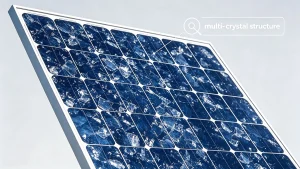
Polycrystalline panels are made by melting multiple silicon fragments together and letting them solidify. The result works fine, but it is not as structurally consistent. Where fragments meet, tiny boundaries form that can slow electron movement slightly.
2.1 Appearance and Efficiency
Polycrystalline panels have a distinctive blue, speckled appearance with more square-looking cells. Their efficiency is lower — typically 15–17% for standard panels, with some sources reporting 13–16%. To achieve the same power output, you need 15–25% more roof area than with monocrystalline.
2.2 Market Status in 2026
Polycrystalline has been largely phased out of mainstream production, representing less than 10% of global shipments. Monocrystalline silicon now accounts for over 90% of global panel production. Standard monocrystalline PERC has declined to less than 5% of production as TOPCon takes over.
The price advantage that once made polycrystalline attractive has nearly disappeared. As of 2026, the price premium for monocrystalline over polycrystalline has shrunk to the point where polycrystalline panels offer no meaningful cost advantage on a full installed system.
2.3 When Polycrystalline Might Still Make Sense
-
Very large, unshaded roofs where space is not a constraint
-
Strictly budget-limited projects where every dollar counts upfront
-
Second-hand or surplus markets where panels are available at steep discounts
-
Ground-mounted systems with abundant space
For most new residential installations in 2026, polycrystalline is not recommended. The efficiency penalty and additional mounting costs usually outweigh the small upfront savings.
3. Thin-Film Solar Panels: Lightweight and Specialized
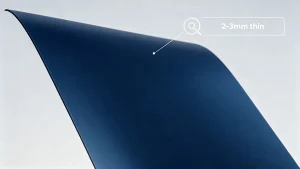
Thin-film panels are made by depositing ultra-thin layers of photovoltaic material — such as cadmium telluride (CdTe) or copper indium gallium selenide (CIGS) — onto a substrate like glass, metal, or plastic.
3.1 Appearance and Efficiency
Thin-film panels are lightweight and flexible, with a uniform dark appearance. Their efficiency is lower than crystalline silicon: CdTe commercial modules ship at 18.8–19.7% efficiency, while CIGS modules achieve 14–17%. Thin-film efficiency is typically 2–3 percentage points lower than crystalline silicon.
3.2 Unique Advantages
Thin-film panels offer better low-light performance than crystalline silicon. They utilize diffuse light 34% more efficiently and maintain 85% output under low-light conditions. Their temperature coefficient is also favorable.
They are lightweight and can be rolled for curved surfaces like tents or RVs. For applications where weight or flexibility is critical, thin-film can solve problems that silicon cannot.
3.3 Best Use Cases
-
Large flat commercial or utility roofs
-
RVs, campers, boats, and portable applications
-
Structures with weight limitations that cannot support heavy glass panels
-
Architectural integration where aesthetics or curvature matters
For most residential rooftops, thin-film is not recommended. The lower efficiency means you need more roof area for the same output, and the shorter lifespan (typically 10–20 years) does not align with the 25+ year expected life of a home solar investment.
4. Comparison Summary
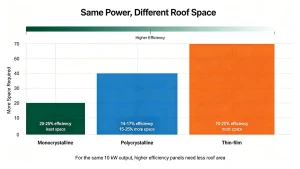
| Feature | Monocrystalline | Polycrystalline | Thin-Film |
|---|---|---|---|
| Efficiency | 20–25% | 14–17% | 10–20% |
| Appearance | Black, uniform | Blue, speckled | Dark, uniform |
| Lifespan | 25–40 years | 20–25 years | 10–20 years |
| Space Needed | Least | 15–25% more | Most |
| Cost per Watt | Moderate | Slightly lower | Varies |
| Market Share (2026) | 90%+ | <10% | Niche |
| Best For | Residential rooftops | Large budget projects | Specialty applications |
5. How to Choose: A Simple Framework
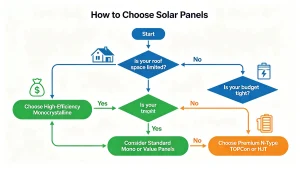
Step 1: Assess Your Roof Space
If your roof is small, shaded, or interrupted by vents and dormers, efficiency matters. A 25% efficient panel can deliver 10 kW on 40 m², while a 21% panel would only deliver 8.4 kW on the same area. One percentage point of efficiency gain translates to roughly 4 fewer panels on a 10 kW system.
Step 2: Consider Your Climate
In hot climates — Mediterranean, Middle Eastern, Australian — the temperature coefficient matters more than STC efficiency. Panels with lower temperature coefficients lose less output in summer heat. Premium N-type TOPCon and HJT panels offer the best temperature performance.
Step 3: Evaluate Your Budget
If you have ample roof space, standard efficiency panels often deliver better overall value. If space is tight, premium efficiency is worth paying for. Panels in the 22–23% range now sit at the price-performance sweet spot — they deliver 90% of premium panel performance at roughly 70% of premium pricing.
Step 4: Look Beyond the Wattage Label
The wattage stamped on a panel is measured under Standard Test Conditions (25°C, 1,000 W/m²) — not real-world conditions. What wattage does not tell you:
-
Temperature coefficient — how much output drops in heat
-
Degradation rate — how quickly the panel loses power annually
-
Low-light performance — how well it generates on cloudy days
-
Power tolerance — whether you get what you pay for
6. The Verdict for 2026
For nearly all residential installations, monocrystalline is the right choice. The efficiency advantage, longer lifespan, and shrinking price gap make it the clear winner. Within monocrystalline, N-type TOPCon offers the best balance of performance and cost in 2026. HJT panels carry the best temperature coefficients but cost 10–15% more.
Polycrystalline panels are effectively obsolete for new residential systems. Thin-film panels are specialty products best reserved for commercial roofs, portable applications, or situations where weight and flexibility are the primary constraints.
The solar panel market has already voted: monocrystalline is the standard. The only question is which monocrystalline variant — PERC, TOPCon, or HJT — best fits your specific roof, climate, and budget.