Grid-Tied vs. Off-Grid vs. Hybrid: Which Solar System Is Right for You?
Walk into any solar discussion and you will hear three terms: grid-tied, off-grid, and hybrid. They sound technical, but the differences between them are straightforward — and they determine everything from your upfront cost to whether your lights stay on during a blackout.
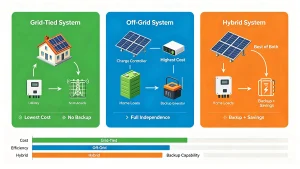
For years, homeowners were told there were only two real choices in solar: grid-tied or off-grid. That is no longer the full picture. In 2026, the smarter comparison is usually grid-tied, grid-tied with battery storage (hybrid), and off-grid. This guide breaks down exactly how each system works, what it costs, and where each option makes the most sense.
1. Grid-Tied (On-Grid) Systems: The Standard Choice
A grid-tied solar system connects your solar panels directly to the utility grid. Your panels generate DC electricity, an inverter converts it to AC power for your home, and when your production exceeds your consumption, the surplus flows to the grid. When your panels are not producing enough — at night or on cloudy days — your home draws power from the grid. There is no battery. The grid acts as your virtual storage.
1.1 How It Works
-
Solar panels generate DC power
-
A grid-tied inverter converts DC to AC
-
Your home uses solar energy first
-
Surplus energy is exported to the grid
-
The grid fills the gap when solar production falls short
1.2 Advantages
Lowest upfront cost. No batteries, no charge controllers, no backup switchgear. A residential grid-tied system typically costs 40–60% less than an equivalent off-grid system. Standard grid-tied systems remain the most cost-effective option for most grid-connected homeowners in 2026.
Fastest payback. Net metering credits offset grid consumption at retail or near-retail rates in many markets. Payback periods of 4–7 years are common in Europe and parts of the US. Grid-tied systems represent over 95% of residential solar installations.
Highest system efficiency. No battery charge/discharge losses (typically 10–15% round-trip loss). Every kWh generated is either consumed or exported.
Simplest design and maintenance. Fewer components, shorter commissioning time, no battery replacements, no charge controller diagnostics.
1.3 Disadvantages
No outage protection. When the grid goes down, the inverter shuts down due to anti-islanding safety requirements — even if your panels are producing power at noon on a sunny day. This is an industry-mandated safety standard to prevent back-feeding electricity to the grid and endangering utility workers.
Grid-dependent. You cannot operate independently. The system only works when the utility grid is functioning.
1.4 Who It’s Best For
Grid-tied systems are ideally suited for homeowners in regions with reliable utility infrastructure, favorable net metering policies, and a primary goal of reducing electricity bills rather than ensuring outage protection. If you live in a city with stable grid service and want the lowest possible upfront cost and fastest return on investment, grid-tied is likely your best choice.
2. Off-Grid Systems: Complete Energy Independence
An off-grid solar system operates completely independently from the utility grid. There is no connection to utility service at all. Solar panels charge a battery bank through a charge controller, and an off-grid inverter converts stored DC energy to AC power for your home. When solar generation and battery capacity fall short — during extended cloudy periods or unusually high consumption — a backup generator typically steps in.
2.1 How It Works
-
Solar panels generate DC power
-
A charge controller or hybrid inverter manages battery charging
-
Batteries store excess energy for later use
-
An inverter powers household loads with AC electricity
-
A backup generator often steps in during long cloudy periods
2.2 Advantages
Complete energy independence. No utility bills, no grid dependency, no vulnerability to grid outages or rate hikes. An off-grid system can be deployed anywhere — islands, remote mountain cabins, rural properties without utility access.
Reliable during outages. Unlike grid-tied systems, off-grid systems keep running when the grid goes down. Power is always available as long as the battery has charge.
Freedom of location. You are not limited to properties with grid access. Off-grid makes financial sense when grid extension costs exceed $10,000–$20,000.
2.3 Disadvantages
Highest upfront cost. Batteries are expensive. A complete off-grid system for a family home in Canada costs $30,000–$55,000. In Australia, an off-grid system sized for 10 kWh daily consumption could cost around $55,000 installed. LiFePO4 cell prices have dropped to $60–$80/kWh at the cell level, but installed pack costs for residential storage still sit between $300/kWh and $600/kWh.
Complex design. Because there is no grid to fall back on, every kWh of anticipated demand must be covered by panel capacity, battery storage depth, or generator runtime. Undersizing creates real risk: lights go out, refrigerators warm up, medical equipment fails.
Energy waste. When solar generation exceeds battery capacity, surplus energy cannot be exported — it is simply wasted.
Higher maintenance. Battery replacements, charge controller diagnostics, generator fuel management. Off-grid is demanding to maintain.
2.4 Who It’s Best For
Off-grid systems are designed for situations where utility service is unavailable, extremely expensive to extend, or unreliable enough that full independence is worth the extra cost. Typical use cases include remote cabins, mountain properties, islands, rural farms, RVs, and boats. For most urban and suburban homeowners, off-grid is overkill.
3. Hybrid Systems: The Best of Both Worlds
A hybrid solar system is a grid-connected solar system paired with battery storage. It combines the lower cost and flexibility of grid connection with the resilience and load-shifting benefits of batteries. A hybrid setup is not fully off-grid, but it solves the biggest weakness of a plain grid-tied system: it can keep at least part of your home running when the grid goes down.
3.1 How It Works
The core of a hybrid system is the hybrid inverter, which combines three functions in one device: grid-connected operation, off-grid operation, and battery charging and discharging. It brings together the strengths of both grid-tied and off-grid inverters. Modern hybrid inverters reach 96–99% efficiency in lab testing.
A hybrid inverter operates in multiple modes:
Grid-Tied Generation Mode: Solar panels produce DC power. The inverter converts it to AC, powering home loads first. Surplus energy is either fed into the grid or stored in the battery.
Energy Storage Mode: When daytime solar exceeds total load, surplus charges the battery. At night, when rates are lowest, the system can charge the battery from cheap grid power, enabling peak-valley arbitrage.
Off-Grid Power Supply Mode: If the grid fails, the system disconnects and switches to off-grid mode in milliseconds. The battery releases DC power, which the inverter converts to stable AC for home loads. No manual action is needed.
Grid Backup Mode: If the battery drops below its protection threshold, the system reconnects to the grid. The grid powers the load and can recharge the battery.
3.2 Advantages
Outage protection. When the grid goes down, hybrid systems automatically switch to battery power. Most mainstream products switch within 10–20 milliseconds — effectively seamless.
Self-consumption optimization. Store excess solar energy produced during the day and use it at night or during peak-rate periods. Avoid buying expensive electricity from the grid.
Peak-valley arbitrage. In regions with significant time-of-use rate differences, you can charge the battery when electricity is cheap and discharge during expensive peak periods.
Flexibility. You can export surplus energy to the grid when rates are favorable or store it when rates are low. Hybrid systems offer the most control over energy flow.
3.3 Disadvantages
Higher cost than grid-tied. Batteries add significant expense. Lithium-ion batteries typically add 40–50% to system price. However, the global hybrid inverter market is valued at over $10 billion in 2026, and more than 55% of new rooftop solar installations now include a hybrid-ready configuration.
Slightly lower efficiency. The pure conversion efficiency of a hybrid inverter is 1–2% lower than a dedicated grid-tied system because it also manages the flow to and from the battery.
More complex. Additional components, more sophisticated control logic, and more points of potential failure.
3.4 Who It’s Best For
Hybrid systems are the ideal middle ground for most homeowners in 2026. They are particularly well-suited for:
-
Homes in areas with frequent outages (more than 5 per year)
-
Households with critical loads — medical equipment, security systems, home offices
-
Regions with significant peak-valley electricity rate differences
-
Homeowners who want both bill savings and backup security
4. Side-by-Side Comparison
| Feature | Grid-Tied | Off-Grid | Hybrid |
|---|---|---|---|
| Grid Connection | Required | None | Optional, automatic切换 |
| Battery Required | No | Yes | Yes |
| Outage Protection | None — system shuts down | Full — continues operating | Full — automatic switchover |
| Surplus Energy | Exported to grid | Stored or wasted | Export or store — flexible |
| Upfront Cost | Lowest | Highest | Moderate–High |
| System Efficiency | Highest — no battery loss | Lower — battery loss | Moderate — 1–2% below grid-tied |
| Payback Period | 4–7 years | 10+ years | 6–10 years |
| Maintenance | Simplest | Most demanding | Moderate |
| Best For | Urban, grid-reliable homes | Remote, no-grid locations | Suburban & urban homeowners seeking backup |
5. How to Choose: A Simple Framework
Step 1: Assess Your Grid Situation
If you live in a city with reliable grid service and favorable net metering, grid-tied is the most cost-effective option. If you live in a remote area without grid access or where extension costs exceed $10,000–$20,000, off-grid may be necessary. If you have grid access but want backup protection or live in an area with frequent outages, hybrid is the clear winner.
Step 2: Define Your Goals
-
Primary goal: lower electricity bills with minimum upfront cost → Grid-tied
-
Primary goal: complete energy independence regardless of location → Off-grid
-
Primary goal: bill savings plus outage protection and rate arbitrage → Hybrid
Step 3: Consider Your Budget
Grid-tied systems offer the fastest return and lowest barrier to entry. Hybrid systems cost more upfront but deliver both savings and security. Off-grid systems are the most expensive and should only be considered when grid connection is not feasible or when full independence is non-negotiable.
Step 4: Look at the Future
In 2026, more than 55% of new rooftop solar installations now include a hybrid-ready configuration. Even if you do not add a battery today, choosing a hybrid-ready inverter leaves the door open for future battery addition. Grid-tied systems are the cheapest today, but they cannot be easily upgraded to provide backup without replacing the inverter.
6. Bringing It All Together
The three system architectures represent fundamentally different philosophies about how your home interacts with energy:
-
Grid-tied treats the grid as an infinite virtual battery. It is the cheapest, simplest, and most efficient — but it leaves you powerless during outages.
-
Off-grid treats the grid as irrelevant. It offers complete freedom but demands careful design, large batteries, and significant upfront investment.
-
Hybrid treats the grid as a partner. It gives you the best of both worlds — grid access when you want it, battery backup when you need it, and the flexibility to optimize energy use based on time-of-use rates.
For the vast majority of homeowners in 2026, hybrid is the smartest long-term choice. It costs more than grid-tied today but delivers outage protection, rate arbitrage, and the flexibility to adapt as electricity rates and grid reliability continue to change. If budget is tight now, start with a grid-tied system with a hybrid-ready inverter — and add the battery later when funds allow.