Walk into any solar discussion and you will hear people throw around numbers: “10 kW system,” “13.5 kWh battery,” “whole-home backup.” But what do these numbers actually mean for your home? Sizing a solar-plus-storage system is not about picking the biggest system you can afford — it is about matching three numbers: usable battery energy (kWh) to your loads and desired backup duration, battery power (kW) to your largest simultaneous loads, and daily PV output to recharging the battery plus daytime consumption.
This guide walks you through the entire sizing process step by step, with real formulas you can use and a worked example at the end.
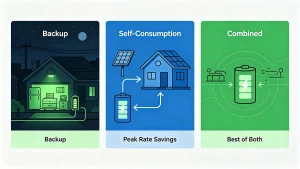
1. Know Your Goal: Backup, Self-Consumption, or Both
Before you pick up a calculator, you need to answer one question: What is this battery for?
Most sizing guides fail because they treat backup power and solar self-consumption as the same math problem. They are not. A homeowner in Houston who wants 48 hours of refrigerator and medical equipment runtime during hurricane season needs a fundamentally different calculation than a homeowner in San Diego trying to maximize time-of-use savings.
1.1 Backup Power (Resilience)
You want the battery to keep your home running when the grid goes down. The question is: How long? Backup sizing is driven by autonomy — the number of hours or days the battery must power critical loads without grid support.
1.2 Self-Consumption (Economics)
You want to store excess solar energy produced during the day and use it at night or during peak-rate periods. This avoids buying expensive electricity from the grid. Self-consumption sizing is driven by daily solar surplus — how much excess energy your panels generate that would otherwise be exported.
1.3 Combined Approach
Most homeowners want both — backup and bill savings. A combined approach typically requires more capacity than self-consumption alone but less than whole-home backup for multiple days.
2. Step 1: Calculate Your Daily Energy Consumption
The foundation of every sizing exercise is knowing how much electricity you use.
2.1 Find Your Usage
The easiest way is to look at your utility bills. Find your average daily kilowatt-hour (kWh) consumption. The average U.S. home consumes about 30 kWh per day, but your actual usage could be anywhere from 10 kWh (efficient small home) to 60+ kWh (large home with electric heating and EVs).
2.2 Identify Critical Loads (For Backup)
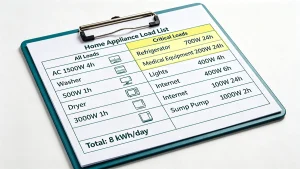
If you are sizing for backup, you do not need to power everything. Identify your critical loads — appliances and systems that must remain powered during outages:
-
Refrigerator / freezer
-
Medical equipment
-
Basic lighting
-
Internet / communication devices
-
Sump pump or well pump
-
Heating/cooling (at least partially)
Make a list with each appliance’s wattage and estimated daily run hours. Multiply: Watts × Hours = Watt-hours (Wh) per day. Sum them up and divide by 1,000 to get kWh.
2.3 Consider Future Loads
If you plan to buy an electric vehicle, install a heat pump, or add a home office, factor those into your consumption now. It is much cheaper to size the system correctly upfront than to add capacity later.
3. Step 2: Size the Battery Bank (kWh)
This is where the math gets specific. Your battery sizing formula depends entirely on your goal.
3.1 Formula A: Backup Power Sizing
If your customer wants backup power, use this formula:
(Critical Load kWh × Days of Autonomy × Safety Factor) ÷ (DoD × Round-Trip Efficiency) = Required Battery Capacity (kWh)
Let us break down each term:
-
Critical Load kWh — your daily critical load consumption from Step 2
-
Days of Autonomy — how many days you want the battery to run without solar input (typically 1–3 days)
-
Safety Factor (1.2) — a 20% buffer for unexpected usage or degradation
-
DoD (Depth of Discharge) — how much of the battery’s rated capacity you can actually use. Lithium-ion batteries allow 80–95% DoD; lead-acid typically only 50%
-
Round-Trip Efficiency — energy lost during charge/discharge. High-quality lithium batteries offer 85–95% efficiency
Example: A home with 10 kWh of daily critical loads, wanting 2 days of autonomy, using an LFP battery at 90% DoD and 90% efficiency:
(10 × 2 × 1.2) ÷ (0.90 × 0.90) = 24 ÷ 0.81 = 29.6 kWh of rated battery capacity
3.2 Formula B: Self-Consumption Sizing
If your primary goal is storing daily solar surplus to avoid buying peak-rate electricity, use this formula:
(Daily Evening Peak kWh × Efficiency Buffer) ÷ DoD = Required Battery Capacity (kWh)
-
Daily Evening Peak kWh — how much energy you consume during expensive rate periods (typically 4–9 PM)
-
Efficiency Buffer (1.15) — accounts for round-trip losses
Example: A home uses 8 kWh during peak evening hours, with an LFP battery at 90% DoD:
(8 × 1.15) ÷ 0.90 = 9.2 ÷ 0.90 = 10.2 kWh
3.3 The 2:1 Rule of Thumb
A battery sized beyond a 2:1 solar-to-storage ratio provides diminishing returns. For example, a 6 kW solar array producing about 24 kWh daily pairs well with 10–15 kWh of storage. Going beyond that rarely delivers additional economic value.
3.4 The Usable Capacity Trap
Battery manufacturers always lead with the nominal kilowatt-hour rating — 13.5 kWh, 16.0 kWh — as if that number alone answers the sizing question. It does not. The usable capacity, after accounting for DoD limits, round-trip efficiency losses, temperature derating, and inverter idle draw, can be 20–35% lower than the headline figure. A “13.5 kWh” battery may deliver only 10.5–11.0 kWh of real, available energy to your loads on a cold morning after two years of cycling.
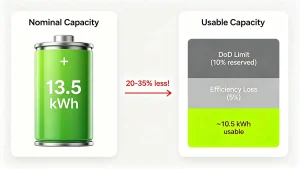
Always size using usable capacity, not nominal capacity.
4. Step 3: Size the Solar Array (kW)
Your solar panels must generate enough energy to cover three things:
-
Your daytime consumption
-
Recharging the battery (the energy you used overnight)
-
System losses
4.1 The Array Sizing Formula
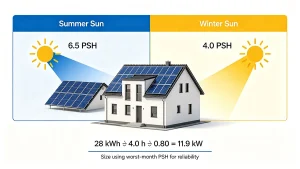
Daily Load (kWh) ÷ Peak Sun Hours ÷ System Efficiency = Array Size (kW)
-
Daily Load — your total daily consumption (including what you need to recharge the battery)
-
Peak Sun Hours (PSH) — the average number of hours per day when sunlight is strong enough for full-rated output. This varies by location and season. In winter, production may be 30–70% lower than summer
-
System Efficiency (0.75–0.85) — accounts for losses from wiring, inverter conversion, temperature, soiling, and aging
Example: A home with 25 kWh daily load, in a location with 5 peak sun hours, using 0.80 efficiency:
25 ÷ 5 ÷ 0.80 = 5 ÷ 0.80 = 6.25 kW array
4.2 Panel Quantity
Divide your array size (kW) by the wattage of each panel. If you choose 400 W (0.4 kW) panels:
6.25 kW ÷ 0.4 kW = ~16 panels
5. Step 4: Size the Inverter (kW)
The inverter must handle your peak simultaneous load — the highest amount of power your home might draw at any single moment.
5.1 Continuous Power vs. Surge Power
-
Continuous power rating — the steady power the inverter can deliver indefinitely
-
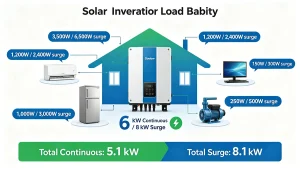
Surge power rating — the short burst needed to start motors (refrigerators, well pumps, air conditioners). Surge loads can be 2–3× the running wattage
5.2 The Sizing Rule
Your inverter’s continuous power rating should exceed your peak simultaneous load. Most homes need 5–8 kW inverters; larger homes with electric appliances may need 10–15 kW.
Example: If you run a refrigerator (700 W running / 2,100 W surge), lights (500 W), TV (200 W), and a well pump (1,000 W running / 3,000 W surge) simultaneously, your peak load is:
700 + 500 + 200 + 1,000 = 2,400 W continuous, with a surge requirement of 5,100 W
A 5 kW continuous / 6 kW surge inverter would be appropriate.
6. Worked Example: The Johnson Family
Let us put it all together with a real example.
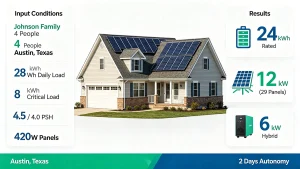
The Johnsons (Austin, Texas):
-
4-bedroom home, 2,200 sq ft
-
Average daily consumption: 28 kWh (from utility bills)
-
Critical loads: refrigerator, freezer, lights, internet, medical CPAP machine = 8 kWh/day
-
They want: 2 days of backup for critical loads + self-consumption optimization
-
Location: 5.5 peak sun hours (summer), 4.0 peak sun hours (winter)
-
Panel choice: 420 W monocrystalline
-
Battery choice: LFP, 90% DoD, 90% round-trip efficiency
Step 1: Battery Sizing (Backup Focus)
Using Formula A for 2 days of autonomy:
(8 kWh × 2 days × 1.2) ÷ (0.90 × 0.90) = 19.2 ÷ 0.81 = 23.7 kWh rated capacity
For self-consumption, they would need about 10–12 kWh. Since they want both, they size for the larger number: ~24 kWh of rated battery capacity (usable: ~19–20 kWh).
Step 2: Solar Array Sizing
They need to cover daily consumption (28 kWh) plus recharge the battery after an outage. On a normal day, they use 28 kWh and the battery provides about 10 kWh of evening power, so total daily requirement is roughly 38 kWh.
Using winter peak sun hours (the worst case):
38 kWh ÷ 4.0 PSH ÷ 0.80 efficiency = 38 ÷ 3.2 = 11.9 kW array
With 420 W panels: 11,900 W ÷ 420 W = ~29 panels
Step 3: Inverter Sizing
Their peak simultaneous load: A/C (3,500 W), refrigerator (700 W), lights (400 W), TV (200 W), computer (300 W) = 5,100 W continuous
They choose a 6 kW hybrid inverter with an 8 kW surge rating.
Summary
| Component | Sizing Result |
|---|---|
| Battery | ~24 kWh rated (LFP, 90% DoD) |
| Solar Array | ~12 kW (29 × 420 W panels) |
| Inverter | 6 kW hybrid |
7. Common Sizing Mistakes to Avoid
7.1 Sizing for the Wrong Goal
Do not size a battery for backup when the homeowner primarily wants bill savings — or vice versa. The formulas are different, and the wrong choice costs $5,000–$15,000 in oversized or undersized hardware.
7.2 Ignoring Seasonal Variation
In winter, production may be 30–70% lower than summer. Always size using worst-month solar data for off-grid or backup-critical systems.
7.3 Forgetting About Degradation
Batteries lose capacity over time. A battery that perfectly covers your needs today may fall short in year 8. Build in a margin — typically 10–20%.
7.4 Undersizing the Inverter
kWh tells you how long you can run. kW tells you what you can run simultaneously. A battery with plenty of energy (kWh) but an undersized inverter (kW) cannot start your air conditioner.
8. Bringing It All Together
Sizing a solar-plus-storage system follows a logical sequence:
-
Define your goal — backup, self-consumption, or both
-
Calculate your daily load — total consumption and critical loads
-
Size the battery — use the right formula for your goal, and always use usable capacity
-
Size the array — cover daily consumption plus battery recharge, using worst-month sun hours
-
Size the inverter — handle your peak simultaneous load plus surge requirements
Most homes need 10–20 kWh for partial backup and 20–40 kWh for whole-home backup. A typical 6 kWp solar system pairs well with 10–15 kWh of storage. But your actual numbers depend on your home, your habits, and your goals — not on a generic rule of thumb.