Solar energy is the fastest-growing source of electricity in the world, and for good reason. It is clean, renewable, and—thanks to decades of innovation—more affordable than ever before. But if you are new to the world of solar power, the technology can feel overwhelming. What exactly are solar panels? How do they turn sunlight into electricity? And why do you need a battery?
This guide will walk you through the basics of solar panels, battery storage, and the different system types available. By the end, you will have a clear understanding of how a solar-plus-storage system works and whether it might be right for you.
1. How Solar Panels Work: The Photovoltaic Effect
At the heart of every solar panel is a phenomenon called the photovoltaic (PV) effect. This is the process by which sunlight is converted directly into electricity.
1.1 The Role of Semiconductors
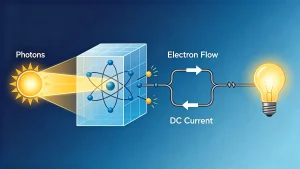
Solar panels are made from semiconductor materials—most commonly silicon. A semiconductor is a material that conducts electricity only when energy is provided, such as from sunlight. When photons (particles of sunlight) strike a solar cell, they transfer their energy to electrons in the semiconductor material. This energy knocks the electrons loose from their atoms, allowing them to move freely.
1.2 Creating an Electrical Current
Solar cells are specially treated to create an internal electric field. This field forces the freed electrons to move in a single direction, generating a flow of electrical current. This current is what we harness as electricity.
1.3 From Cells to Panels to Arrays
A single PV cell is quite small and typically produces only 1 or 2 watts of power—enough for a calculator or a wristwatch, but not much else. To generate meaningful amounts of electricity, cells are connected together and packaged into weather-tight units called panels (or modules). Panels can then be grouped into arrays to produce even more power.
1.4 DC vs. AC Electricity
Solar cells generate direct current (DC) electricity, meaning the electric charge flows in one direction. However, most homes and the utility grid use alternating current (AC) electricity. This is where the inverter comes in—a device that converts DC from your solar panels into usable AC power for your home.
2. Types of Solar Panels: Which One Is Right for You?
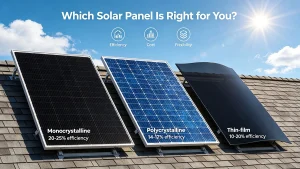
Not all solar panels are created equal. The three main types are monocrystalline, polycrystalline, and thin-film. Each has its own strengths and weaknesses.
2.1 Monocrystalline Solar Panels
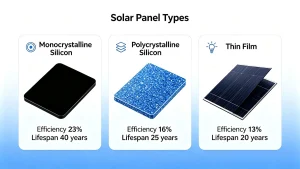
Monocrystalline panels are made from a single, pure silicon crystal. They have a sleek, uniform black appearance and are the most efficient type available, with efficiencies ranging from 19% to 23%. They also have the longest lifespan, typically 25 to 40 years.
Best for: Homes with limited roof space where high efficiency is a priority. They are also the most expensive option.
2.2 Polycrystalline Solar Panels
Polycrystalline panels are made by melting multiple fragments of silicon together. They have a characteristic blue, speckled look and are less expensive to manufacture. However, they are less efficient—typically 13% to 16%—and have a shorter lifespan of 20 to 25 years.
Best for: Budget-conscious installations where space is not a constraint. Note that polycrystalline panels have largely been phased out of mainstream production, with monocrystalline now representing over 90% of global panel production.
2.3 Thin-Film Solar Panels
Thin-film panels are made by depositing ultra-thin layers of photovoltaic material onto a substrate like glass, metal, or plastic. They are lightweight and flexible, with efficiencies ranging from 10% to 18% and a lifespan of 10 to 20 years.
Best for: Specialized applications where flexibility or weight is a concern, such as on curved surfaces or in large-scale industrial settings. They are generally not recommended for most residential rooftops.
3. How Solar Battery Storage Works
Solar panels generate electricity only when the sun is shining. At night or on cloudy days, production drops or stops entirely. This is where battery storage comes in.
3.1 Why Storage Matters
Storage allows you to capture excess electricity produced during the day and use it later—when the sun isn’t shining or when electricity rates are highest. Without storage, any surplus electricity your panels generate is either exported to the grid (if you have a grid-tied system) or wasted.
3.2 Lithium-Ion Batteries
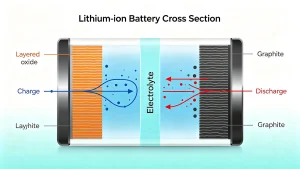
Most modern solar batteries are lithium-ion batteries. They store energy through a chemical reaction: when electricity is fed into the battery, it causes lithium ions to move between electrodes, storing energy as chemical potential. When the battery is discharged, that reaction is reversed, releasing electricity.
A Battery Management System (BMS) monitors the battery’s voltage, temperature, and state of charge to ensure safe and efficient operation. Lithium-ion batteries offer better performance and longevity than older lead-acid alternatives, making them the standard choice for home energy storage.
3.3 The Role of the Inverter in Storage Systems
In a solar-plus-storage system, the inverter does more than just convert DC to AC. A hybrid inverter can manage multiple energy pathways: it converts solar DC to AC for your home, charges the battery from solar, and can even draw from the battery during outages or peak-rate periods. This makes hybrid inverters the central “brain” of a modern solar storage system.
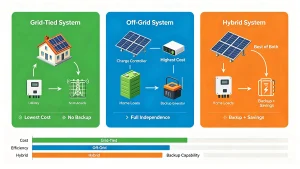
4. Types of Solar Systems: Grid-Tied, Off-Grid, and Hybrid
When designing a solar power system, you have three main architectural choices.
4.1 Grid-Tied (On-Grid) Systems
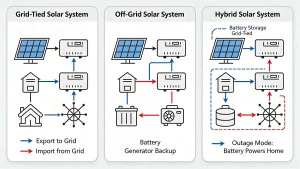
A grid-tied system connects your solar panels directly to the utility grid. There is no battery. When your panels produce more electricity than you need, the surplus flows to the grid. When they produce less, you draw power from the grid.
Pros: Lowest upfront cost (40–60% less than off-grid), fastest payback (4–7 years in many markets), and highest system efficiency since there are no battery charge/discharge losses.
Cons: No outage protection. When the grid goes down, the system shuts off for safety reasons.
Best for: Homeowners in areas with reliable grids who want to lower their electricity bills.
4.2 Off-Grid Systems
An off-grid system is completely independent of the utility grid. It requires solar panels, batteries, a charge controller, and often a backup generator.
Pros: Full energy independence.
Cons: Highest upfront cost, requires careful battery sizing, and you must manage your own energy supply.
Best for: Remote locations where grid access is unavailable.
4.3 Hybrid Systems
A hybrid system combines the best of both worlds: it is connected to the grid but also includes battery storage. During the day, solar powers your home and charges the battery. Surplus can still be exported to the grid. At night or during outages, the battery supplies power.
Pros: Outage protection, ability to optimize self-consumption, and potential to sell power back during high-rate periods.
Cons: Higher cost than grid-tied, but more flexible.
Best for: Homeowners in regions prone to outages or those who want both savings and backup security.
5. Bringing It All Together
A complete solar-plus-storage system consists of four main components:
-
Solar panels – capture sunlight and convert it to DC electricity
-
Inverter – converts DC to AC power for your home
-
Battery storage – stores excess energy for later use
-
Monitoring system – tracks production, consumption, and battery status
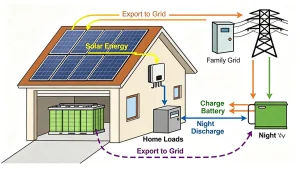
When sized correctly, a solar-plus-storage system can dramatically reduce your reliance on the grid, lower your electricity bills, and provide backup power during outages. With solar energy now one of the cheapest sources of new electricity generation, there has never been a better time to explore your options.