How Solar Batteries Work: A Complete Guide to Lithium-Ion Energy Storage
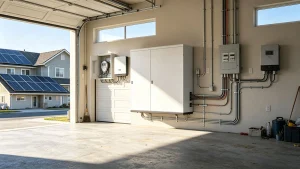
If you have ever looked at the sleek white box on your garage wall and wondered what is actually happening inside, you are not alone. Solar batteries have become the defining technology of the 2020s energy transition, yet for most homeowners, they remain a black box — literally and figuratively.
This guide will walk you through exactly how a lithium-ion battery stores and delivers energy, from the atomic level to the complete home system. By the end, you will understand what happens when your solar panels charge the battery and what happens when you run your air conditioner at night.
1. The Basic Architecture: What Is Inside a Battery Cell?
Every lithium-ion battery cell — whether it is in your phone, your electric car, or your home storage system — shares the same fundamental structure.
1.1 The Five Core Components
A battery cell has five essential parts:
-
Anode (negative electrode) — typically made of graphite. This is where lithium ions are stored when the battery is charged.
-
Cathode (positive electrode) — made from a lithium metal oxide. The exact material varies by chemistry: lithium iron phosphate (LFP), nickel manganese cobalt (NMC), or lithium cobalt oxide.
-
Electrolyte — a liquid or gel that carries positively charged lithium ions between the anode and cathode.
-
Separator — a thin, porous membrane that physically separates the anode and cathode. It allows lithium ions to pass through but blocks electrons, preventing short circuits.
-
Current collectors — metal foils (copper on the anode side, aluminum on the cathode side) that collect and conduct the flow of electrons.
1.2 Voltage and Capacity
A single lithium-ion cell produces only about 3.2 to 3.7 volts, depending on the chemistry. A home battery is made by wiring many cells together — typically in series to increase voltage and in parallel to increase capacity — to reach the voltage and energy storage you actually need.
2. The Charging Process: Storing Solar Energy
When your solar panels produce more electricity than your home needs, the excess energy flows into the battery. Here is what happens at the molecular level.
2.1 Lithium Ions Move to the Anode
During charging, an external electrical current (from your solar panels or the grid) pushes lithium ions (Li⁺) from the cathode, through the electrolyte and separator, to the anode, where they are stored. The anode becomes “lithium-rich”.
2.2 Electrons Take the External Path
At the same time, electrons are forced to travel through the external circuit from the cathode to the anode — they cannot pass through the separator. This flow of electrons is what we measure as electrical current.
2.3 Chemical Energy Storage
The energy from your solar panels is now stored as chemical potential energy. The lithium ions are intercalated — inserted into the layered structure of the graphite anode — and held there by the electrochemical potential difference between the two electrodes. The battery is effectively a reservoir of charged particles waiting to be released.
3. The Discharging Process: Powering Your Home
When the sun goes down and your home needs electricity, the process reverses.
3.1 Lithium Ions Return to the Cathode
During discharge, the anode releases lithium ions back through the electrolyte and separator to the cathode. This movement generates a flow of electrons from the anode through your home’s electrical circuits to the cathode — and that flow powers your lights, refrigerator, and everything else.
3.2 Chemical Energy Becomes Electrical Energy
The chemical potential energy stored during charging is now converted back into electrical energy. The lithium ions intercalate into the cathode material, completing the redox (reduction-oxidation) reaction. When the flow of lithium ions from the anode to the cathode has stopped, the battery is fully discharged.
This reversible process — lithium ions shuttling back and forth between two electrodes — is why lithium-ion batteries are often called “rocking-chair batteries”. The ions simply “rock” from one side to the other and back again.
4. Lithium-Ion Chemistries: LFP vs. NMC
Not all lithium-ion batteries are the same. The phrase “lithium-ion” covers a family of chemistries with significantly different performance profiles. For home solar storage, two chemistries dominate the market.
4.1 LFP (Lithium Iron Phosphate)
LFP batteries use a lithium iron phosphate cathode (LiFePO₄) paired with a graphite anode. In 2026, LFP has become the dominant chemistry for residential solar storage, accounting for over 80% of residential battery shipments.
Why LFP wins for solar storage:
-
Cycle life: 3,000–6,000+ cycles at 80% depth of discharge — far exceeding NMC
-
Thermal stability: LFP cells do not enter thermal runaway below approximately 270°C, compared to around 200°C for NMC
-
Safety: LFP is inherently safer and carries lower fire risk
-
Cost: LFP costs roughly $81/kWh versus NMC at $128/kWh (BloombergNEF 2025)
-
No cobalt: LFP contains no cobalt, eliminating supply chain risks
Trade-off: LFP has lower energy density (90–160 Wh/kg) than NMC (150–250 Wh/kg), meaning LFP batteries are heavier and larger for the same capacity.
4.2 NMC (Nickel Manganese Cobalt)
NMC batteries offer higher energy density and perform better in freezing temperatures, but they have shorter cycle life (1,000–2,000 cycles) and carry higher fire risk. NMC is increasingly being displaced by LFP in stationary storage, though it still makes sense in space-constrained or cold-climate applications.
4.3 What This Means for You
For most residential solar installations in 2026, LFP is the clear winner. It lasts longer, runs cooler, costs less per cycle, and is safer to install in or near your home. Major products using LFP include Tesla Powerwall 3, BYD Battery-Box, Enphase IQ Battery 5P, and SimpliPhi.
5. The Battery Management System (BMS): The Brain
A battery is only as good as the system that manages it. The Battery Management System (BMS) is the electronic brain that monitors and controls every aspect of battery operation.
5.1 What the BMS Does
The BMS continuously monitors:
-
Cell voltages — ensuring no cell is overcharged or over-discharged
-
Temperatures — preventing overheating and thermal runaway
-
State of charge (SoC) — estimating how much energy remains
-
State of health (SoH) — tracking capacity degradation over time
5.2 Why the BMS Matters
Lithium-ion batteries are sensitive. Overcharging can cause thermal runaway and fire; over-discharging can permanently damage the cells. The BMS protects against both extremes, balances cells to ensure even wear, and communicates with your inverter to optimize charging and discharging schedules.
In LFP batteries specifically, the flat discharge curve requires precise BMS algorithms to accurately report remaining capacity. Without a good BMS, you might think you have 30% charge left when you actually have 10%.
6. How the Battery Connects to Your Solar System
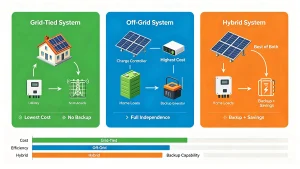
A battery does not work in isolation. It integrates with your solar panels and home electrical system through one of two configurations.
6.1 DC-Coupled Systems
In a DC-coupled system, solar panels feed DC electricity directly into the battery via a charge controller. A single hybrid inverter handles the conversion from DC to AC for your home.
Advantage: Electricity is converted only once, making DC coupling slightly more efficient — you lose less energy in the process.
Best for: New installations where you are designing the entire system from scratch.
6.2 AC-Coupled Systems
In an AC-coupled system, the panels have their own inverter that converts DC to AC immediately. The battery then has a separate inverter that converts AC back to DC for storage, and back to AC again when it discharges.
Advantage: Easier to retrofit onto an existing solar installation, since you are not touching the original panel wiring.
Trade-off: Two conversions instead of one means slightly more energy lost — typically 5–15% round-trip efficiency loss.
7. What Comes Next: Emerging Battery Technologies
While LFP dominates today, the battery industry is evolving rapidly.
7.1 Sodium-Ion Batteries
Sodium-ion is the most commercially credible next technology for residential storage — not because it offers dramatic performance improvements over LFP, but because it removes lithium from the bill of materials entirely. BYD has announced residential sodium-ion storage products for 2026–2027, and CATL is deploying sodium-ion BESS at utility scale.
7.2 Solid-State Batteries
Solid-state batteries replace the liquid electrolyte with a solid material, enabling higher energy density (350–500 Wh/kg) and reduced fire risk. However, true all-solid-state batteries are not yet available for residential solar installations in 2026. LFP remains the safe, cost-effective choice for now.
8. Bringing It All Together
A solar battery is elegant in its simplicity and sophisticated in its execution:
-
Solar panels generate DC electricity.
-
A charge controller or hybrid inverter directs excess energy to the battery.
-
During charging, lithium ions move from the cathode to the anode, storing energy as chemical potential.
-
During discharging, lithium ions flow back, releasing electrons that power your home.
-
A Battery Management System monitors everything to ensure safety and longevity.
-
The battery integrates with your home through DC-coupled or AC-coupled architecture.
Modern lithium-ion batteries achieve 85–95% round-trip efficiency, meaning for every 10 kWh of solar energy you send to the battery, you get 8.5 to 9.5 kWh back when you need it.
The battery on your wall is not magic — it is a carefully engineered electrochemical machine that turns sunlight into stored energy, ready to power your home whenever the sun is not shining.